Environmental News February 2026:
Published 00:00 on 25 Jan 2026

- Bird Aware Solent walk Report
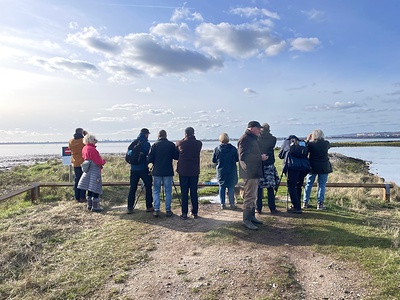
We had a lovely walk last Saturday. Weren't we fortunate with the weather. It was cold but lovely and sunny. We met the BAS rangers at the Oyster Beds carpark and walked all the way round the oyster beds and up to the top of the Billy Trail.
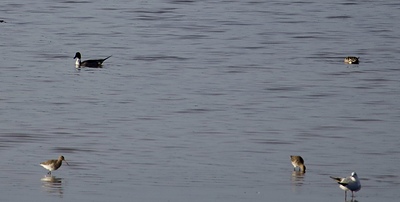
We saw an amazing variety of birds and the highlights were: Redshanks and a Greenshank, 3 male Red Breasted Mergansers chasing a female, Shovlers, Pintails, Avocets and even a couple of Goldeneyes. Plus the usual culprits. Unfortunately most of the best sightings were up at the top of the Billy Trail when some of our group had left to go and watch the football. Was it worth it for them? That is up to you to decide.
- Nature recovery talk by Kate L'Aime Report
Kate gave us a very informative talk on how the Chichester Harbour Protection and Recovery of Nature (CHaPRoN) team are trying to restore areas of Chichester Harbour.
 .
.
As I am sure many of you know, in February 2021, Chichester Harbour Site of Special Scientific Interest (SSSI) was downgraded to an Unfavourable Declining condition.
The aim of CHaPRoN is to try to protect, enhance and drive recovery of the natural environment within Chichester Harbour to help create a landscape more resilient to climate change and to increase the biodiversity of these fragile coastal ecosystems.
It is hoped that by 2050 we will have a Harbour that functions naturally again as a healthy and thriving ecosystem.
There has been an average 68% fall in monitored populations of mammals, birds, amphibians, reptiles and fish between 1970 and 2016 and coastal habitats are no exception with 85% of saltmarsh lost, 100% of seagrass lost in over half English waters and 95% of native oyster populations lost. (The 2020 Global Living Planet Index (LPI))
In February 2021, Natural England published a report that shows that Chichester Harbour has seen a dramatic loss in saltmarsh, sea grass meadows, native oysters and over wintering birds.
- Saltmarsh:
Saltmarsh supports biodiversity, stores carbon, acts as a natural flood and coastal defence as it softens the energy of waves and it also helps improve water quality by absorbing pollutants.
The 2021 Natural England review into the condition of the Chichester Harbour Site of Special Scientific Interest (SSSI) found that saltmarsh had declined by 57 per cent since 1946, and continues to decline at a rate of 2.5 hectares per year (equivalent of 3 football pitches) across Chichester Harbour.
The Good news is that in 2023 the Solent Seascape Project together with Chichester Harbour Conservancy trialled a pioneering technique with dredged sediment to restore saltmarsh at West Itchenor. Monitoring of the trial site to assess the success of the technique is ongoing, and if they can get more funding it is hoped that future phases of the trial will take place.
This short film, produced by the Solent Seascape Project gives an insight into the trial.https://www.conservancy.co.uk/nature-recovery/projects/saltmarsh-restoration-trial-project-west-itchenor/
- Seagrass:
The report estimates that seagrass beds only cover a relatively small area of 136ha, however if conditions are improved, the potential for seagrass beds is far greater.
Globally, seagrass captures carbon up to 35 times faster than tropical rainforests, accounting for 10-18% of total ocean carbon storage despite covering less than 0.1% of the seafloor. Seagrass can also help protect our coast from damaging storms and erosion through dampening the force of waves and is very effective at removing pollutants from our waters. It also supports a spectacular diversity of marine life from endangered seahorses to juvenile fish populations, they are critical to a healthy, functioning marine environment. Yes we do have seahorses in our harbour and Chichester Harbour is a very important Sea Bass nursery.
Sea grass provides sediment stabilisation also supportsadjacent oyster reefs and saltmarsh habitats. In turn, the oyster reefs help to improve local water quality and allow the seagrasses to thrive in healthier waters.
See this video on saving Solent Seagrass https://solentseascape.com/habitats/seagrass/
- Native Oysters:
For hundreds of years native oysters were abundant in Chichester Harbour. But native oyster populations across Europe have plummeted by 95% due to factors including over-fishing, habitat loss, predation, pollution, and invasive non-native species. Native oysters bring significant environmental benefits including for water quality one oyster alone can filter up to 200 litres of water per day. They also remove nitrogen, sequester carbon and provide habitats for other marine life. https://www.conservancy.co.uk/nature-recovery-animation/
The Harbour Oysters team installed 4000 oysters in Emsworth Yacht Harbour last year and they have also installed more, secured in cages under the Chichester Harbour Conservancy public jetty at Itchenor. They are trialling cages at a site that dries out and if that is successful then maybe we would be able to have some cages under our pontoon. Watch this space.
This spring the Solent Seascape Project will undertake a large scale "wild" restoration of native oysters in Chichester Harbour, creating natural habitat on the seabed. A new native oyster reef has already been created on the River Hamble, with underwater film footage last year showing enormous initial success.
To find out more: https://www.conservancy.co.uk/oyster-power-community-action-5000-more-oysters-returned-to-chichester-harbour/
- Wetland birds
This loss of habitat is also impacting dramatically on some wetland bird populations, through loss of high tide roosting sites, nesting sites and changes to food supply and feeding conditions. This is highlighted in particular by the decline in nesting tern populations but affects other important bird species too.
There are three species of tern found in Chichester Harbour: Common Tern, Sandwich Tern and Little Tern. They nest on shingle but their natural nesting habitat has declined significantly in the past 20 years. Nest sites are regularly washed out on high spring tides and storm surges. The result has been a serious decline in the number of terns breeding within the harbour. In fact Nesting Sandwich Tern and Little Tern numbers had declined so much that the number of chicks successfully fledging was at or close to zero.
Fortunately Tern rafts, first launched on Thorney Deeps in 2019 were immediately successful, with 20 young common terns fledging that year. The project funded 5 new rafts, bigger and more resilient than the originals. By 2022 there were 42 pairs of common terns nesting on the rafts, resulting in 54 fledglings and 2025 saw the most successful season yet with at least 75 chicks fledging from the rafts. They have also "recharged" an area of Stakes Island with shingle to raise the island above high spring tides and storm surges. This aimed to provide a safe nesting habitat, primarily for Little Terns. In October 2022 500 tonnes of shingle were deposited on the area, successfully raising the island to ensure it will not be washed over at high spring tides. Two Little Tern chicks fledged there in 2025. Hopefully this year will be even better and eventually the population will recover.
For more information: https://www.conservancy.co.uk/nature-recovery/projects/return-of-the-tern/
And the Tern TV will be back in the Spring. You can watch it here: https://www.conservancy.co.uk/chichester-harbour/wildlife/tern-tv/
- Water Quality:
This animation explains it well. https://www.conservancy.co.uk/water-quality-animation/
For more information: Condition Review of Chichester Harbour sites: intertidal, subtidal and bird features (NERR090).
- Cruiser Owners:

One way we are trying to do our part in helping with the water quality in the harbour is taking extra precautions when removing theold antifouling off our cruisers. For this purpose we have purchased a Class M sander and you can hire this out using the following link: https://langstonesc.simplybook.it/v2/#book/category/8/count/1/
This is to help compliance with the new Lift out procedure which states that "
Sanding of antifouling is not permitted unless a Class-M dustless sanding system is utilised. The Club's Class-M sanding system can be booked for use via the Club website for a nominal charge".